
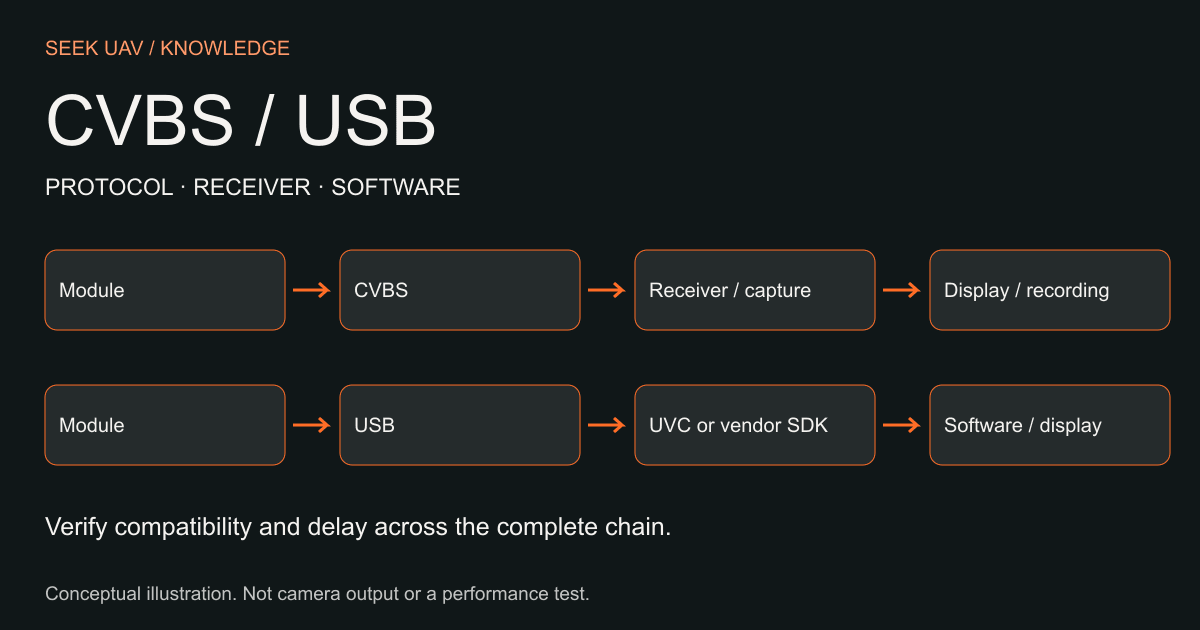
Choose a thermal camera interface by checking what your receiving system can actually accept. CVBS is an analog composite-video path. USB is a digital connection whose video protocol, formats, and software support must be established for the selected module. Neither label alone guarantees a working combination, a particular delay, or access to temperature measurements.
For a drone builder comparing UAV thermal imaging modules, the useful deliverable is a documented camera-to-receiver configuration. Start with the receiver and work back through the required video mode, software, accessories, and module revision. This guide explains that buying decision without prescribing wiring or operational deployment settings.
What CVBS means for a thermal camera
CVBS carries composite analog video. A receiving display or capture device must support the relevant video standard and signal requirements. PAL, NTSC, and other supported formats are capabilities to check, not interchangeable labels. Texas Instruments' composite-video decoder documentation illustrates that decoding and format support belong to the receiving hardware. [1]
A CVBS thermal camera can fit a system that already accepts compatible analog video. The purchasing question is whether the exact camera output and exact receiver input have a documented match. Ask for the current interface document and the supported mode instead of treating a familiar connector shape as evidence.
When a computer records an analog source, a capture device sits between the camera and the application. That device has its own supported modes, drivers, processing, and output format. A recording issue can therefore arise at more than one point. Define the complete equipment list when requesting compatibility confirmation.
USB video and UVC are different levels of description
USB identifies a connection and transport family. UVC, the USB Video Class, defines a standard device class for video. The USB Implementers Forum publishes the class specification. The presence of a USB connection alone does not establish that a camera implements it. [2]
On Windows, Microsoft provides a UVC driver for compliant devices. That is a useful example of class-based support; it is not a statement that every thermal camera works with every computer, phone, application, or operating-system version. Check the supported formats and features against the actual receiving software. [3]
If a module uses a vendor-specific protocol, ask which driver, SDK, documentation, and operating-system versions are available. If it uses UVC, still ask which video modes it exposes and which controls need separate software. A camera being detected and a camera providing all required functions are different acceptance checks.
The phrase USB thermal camera module also does not establish phone compatibility. A connector adapter cannot, by itself, supply missing host support, an application, or a documented video mode. Keep phone-related promises out of a drone-module specification unless the actual hardware and software combination has been verified.
Compare the complete signal paths
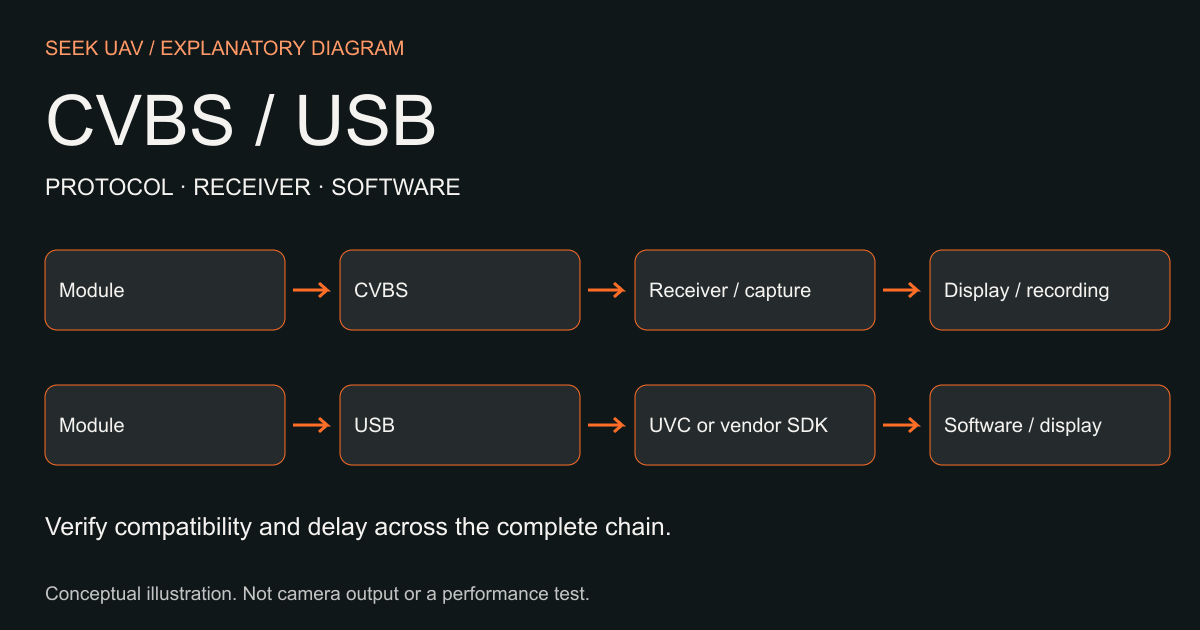
For the analog path, identify the camera's video standard and the receiving or capture stage. For USB, identify the protocol and receiving software. Both paths eventually depend on processing and a display or recording stage. List those stages before discussing performance or declaring compatibility.
| Question | CVBS path | USB path |
|---|---|---|
| What must the receiver support? | Documented analog video standard and input | Documented device protocol and video modes |
| What software information is needed? | Capture-device support when software is involved | UVC support or the appropriate vendor driver/SDK |
| Does the interface establish native resolution? | No; check the detector and video mode separately | No; check the detector and exposed stream separately |
| Does the interface establish temperature data? | No; confirm a supported radiometric data path | No; confirm a supported radiometric data path |
| How should delay be assessed? | Measure the documented complete chain | Measure the documented complete chain |
Native resolution is not transmitted video resolution
A module's native 256×192, 384×288, or 640×512 thermal array describes detector sampling. A video stream can have another frame size because of formatting, scaling, cropping, or processing. The receiver and display add further limits. Keep those specifications separate when comparing a CVBS module with a USB thermal camera.
For example, a capture application may report the dimensions of the frame it receives from a capture device. That number does not prove the size of the original thermal array. Ask for both the detector dimensions and the documented delivered video format. Preserve the original recording and settings when evaluating samples.
If a sample looks stretched, cropped, or unexpectedly soft, record the capture and display settings before changing the module choice. A receiving-chain issue should not become an unsupported conclusion about the sensor. Our resolution guide covers the separate question of choosing between detector classes.
What the SEEK documents establish
The supplied SEEK UAV family datasheet lists DVP, BT656, USB 2.0, and MIPI in its digital-video section. It explicitly adds USB 2.0 UVC for the SEEK 640 DUO. These are documented family entries, not a promise that every interface is exposed on every delivered assembly. [4]
Older SEEK 384 and 640 technical documents describe CVBS/PAL or USB/UVC configurations. Their revision relationship to the current family is not established by the available material. Consequently, the matrix distinguishes current family documentation from historical descriptions rather than combining them into an apparently tested specification. [5, 6]
| SEEK model | Supplied current family datasheet [4] | Scope of the evidence |
|---|---|---|
| SEEK 256 | USB 2.0, MIPI, DVP, BT656 in family digital-video row | Confirm the ordered board, firmware, exposed interfaces, and receiving support |
| SEEK 384 | USB 2.0, MIPI, DVP, BT656 in family digital-video row | Older CVBS/PAL or USB/UVC description is historical; confirm current configuration |
| SEEK 640 | USB 2.0, MIPI, DVP, BT656 in family digital-video row | Older CVBS/PAL or USB/UVC description is historical; confirm current configuration |
| SEEK 640 DUO | Family digital interfaces plus explicit USB 2.0 UVC | No universal host-compatibility or simultaneous-output claim follows |
This distinction prevents an interface list from turning into a guarantee about the assembly in a quotation. If CVBS or a specific UVC mode is required, request explicit confirmation for that order. The current family sheet does not establish a simultaneous CVBS-and-USB operating mode, and this guide makes no such claim.
Simultaneous outputs need their own confirmation
An interface list can describe alternatives, optional boards, or configurable modes. It does not prove that two outputs operate at once. A dual-channel camera also does not automatically provide two independently accessible, synchronized output streams. Record each requirement separately.
Ask which streams are available together, their formats and frame rates, and whether enabling one changes another. Request documentation for the selected hardware and firmware. These are questions for the supplier to resolve before a sample order, not conclusions to draw from a slash-separated marketing list.
Keep delay and temperature data separate from connector choice
End-to-end delay includes acquisition, camera processing, transmission or capture, receiving software, buffering, and display. Neither CVBS nor USB is always faster across all implementations. A useful latency figure names the tested equipment, mode, measurement method, and boundary.
Temperature measurement is another separate requirement. A thermal image rendered in a colour palette is not proof that calibrated per-pixel temperature data is available. Radiometric capability and its data path need model-specific confirmation. FLIR's radiometry guidance explains the distinction between thermal viewing and quantitative temperature information. [7]
Checklist for a documentation or sample request
 Identify the model, hardware revision, receiving equipment, and intended software.
- Ask for the current interface document and the selected video protocol or analog standard.
- Record native detector resolution separately from output size, frame rate, and pixel format.
- Specify whether one output is sufficient or simultaneous streams are required.
- Ask what driver, SDK, controls, and supported host versions apply.
- Request complete assembly mass, power requirements, and included accessories.
- Define whether calibrated temperature data is required, and how it is accessed.
- Agree a sample acceptance test covering detection, a usable stream, recording, and required controls.
Keep the supplier's response with the quotation and the sample record. That gives procurement and engineering the same definition of what is being purchased. If the proposed assembly changes, repeat the compatibility check rather than assuming that the previous result transfers to another board or firmware revision.
Explore SEEK configurations
Send your receiving-system details with the required output and ask for a current configuration recommendation. These links lead to product information and the contact form; they do not imply that an unpublished integration manual is already available.
References
- Texas Instruments — TVP5150AM1 composite-video decoder and supported standards
- USB-IF — Video Class v1.5 specification document set
- Microsoft — USB Video Class driver overview
- SEEK UAV — supplied current family datasheet
- SEEK UAV 384 — historical linked technical document; confirm current applicability
- SEEK UAV 640 — historical linked technical document; confirm current applicability
- FLIR OEM — Radiometry and temperature-data requirements
Questions & answers
Does USB mean that a thermal camera supports UVC?
No. Confirm the device protocol, supported video modes, and software requirements for the selected configuration. USB describes a connection; UVC describes a video device class.
Is CVBS always lower latency than USB?
No universal ranking follows from the interface name. Compare measured complete chains, including capture, buffering, processing, and display, using a stated method and mode.
Can SEEK modules output CVBS and USB simultaneously?
The supplied current family material does not establish that operating mode. Ask for written confirmation for the exact model, board, firmware, and required streams before ordering.
Does USB video contain temperature measurements?
Not necessarily. Confirm radiometric capability and the supported temperature-data format separately from a viewable video stream. UVC compatibility alone does not establish calibrated measurements.
Which documentation should accompany a sample?
Request the model and revision, interface description, supported video modes, host/software requirements, included accessories, and the supplier's response to your compatibility checklist. Keep them with the sample acceptance record.